Arriving at a Decision

Looking through my morning Washington Post Opinion email, I noticed many of the Op-Ed articles were authored by people once known to be right of center. Max Boot, Joe Scarborough, and George Will were once Republicans but now compete to show how much they loath President Trump. They are joined by a legion of other writers once on the right at the Post and other opinion outlets. In the Sunday New York Times, Frank Bruni crowed the Lincoln Project made up the last Bush administration staffers had raised $18 million to run anti-Trump ads. Apparently, the online journal “the Dispatch” raised its capital to criticize the President. All seem poised to cast their vote for Democrat Joe Biden.

As readers of this blog know, I’m no great fan of our present President. I didn’t vote for him in ’16. Faced with the choice between Trump and Clinton, I opted for the Libertarian Ticket. By voting for two successful governors and a chance to expand our options, this was the best I could do. With Justin Amash’s failure to launch, this time, there is no reasonable alternative to the two major-party candidates. It looks like I’ll have to choose between Biden and Trump. (Still time for Michelle)

To come to a decision, a look at how each stands on the significant issues foreign and domestic is mandatory. Neither is going to fully satisfy me, but on balance, which in my opinion would be better. Let’s look at how each candidate might approach Foreign and domestic issues.

Continue reading
Some Observations

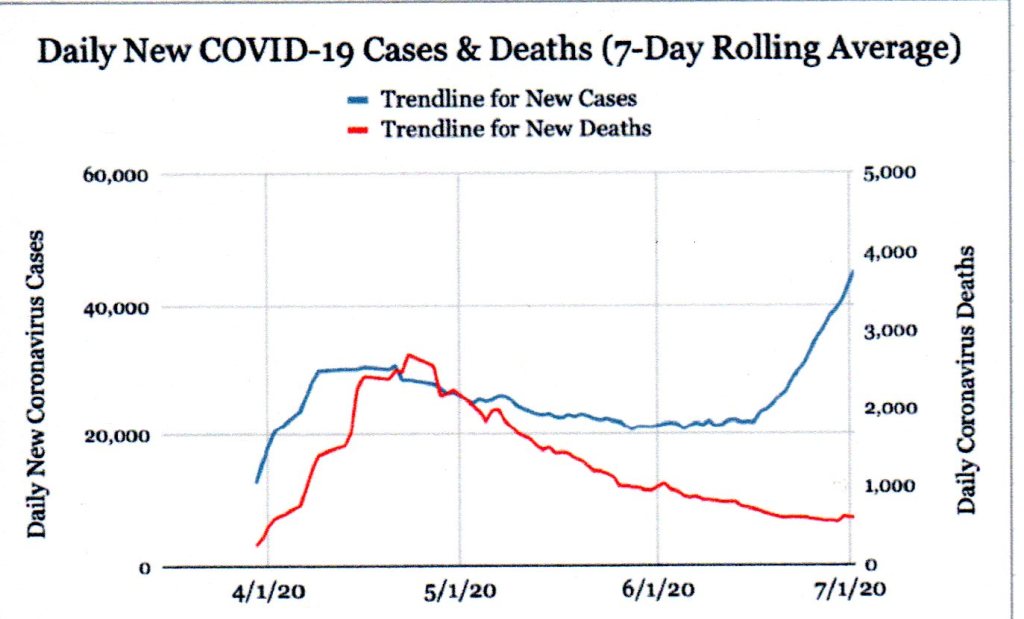
It is interesting to observe some of the things I predicted would happen have taken place. If we did a better job of protecting the elderly and others with underlying conditions, I said we could reopen the country without causing a massive death toll. Younger and healthier people may get the coronavirus in higher numbers, but very few would die. Most of the country has now been opening up. Protecting the vulnerable has been better. Also, people at risk and those close to them are more aware and have taken proper actions. Mask wearing other PPE use around the vulnerable has dramatically expanded. Even Gov. Cuomo now seems to recognize nursing homes must be protected. We still haven’t taken all the measures I proposed, but we have made progress. If better-targeted protections didn’t reduce mortality, then increasing confirmed cases would lead to increased deaths. This chart shows otherwise. Cases have significantly increased, but as I predicted, fatalities haven’t.

Early on, I also wondered why mask-wearing, especially where vulnerable people are present, wasn’t at least encouraged. Even though masks were widely worn in Asia where they had better outcomes, it wasn’t until April 3. The CDC reversed itself and favored masks. There was a shortage of medical gear, but the CDC in April encouraged homemade masks. Peop[e responded. Nothing prevented earlier adoption. This waffling by the authorities has led to needless controversy. Until now, our President seemed to resist wearing a mask. He should’ve set the right example. Can we all agree to wear a mask whenever you might be near an at-risk person? You may save your grandma.

Our failure to do targeted things to protect the at-risk early on has caused needless deaths. Now that more is being done, the results are evident. The better job we do protect the at-risk, the lower the number of deaths. That was always the choice. Not the false one of lives vs. the economy expounded by so many of our leaders.

n my posts at the time of the Ferguson, Mo in 2014 riots after the death of Michael Brown, I warned of the “Ferguson Effect.” If the police were placed in a no-win situation, they would be much less aggressive. This would result in rising crime and murder rates in lower-income areas. The statistics since have borne this out. Rather than recognizing more deprived regions anywhere in the world need more not less police presence, the police are demonized. Instead of striving for a workable community balance to improve the lives in higher crime areas, we have gone in the opposite direction. By disrespecting policing to the point of defunding, the predicable rise in minority deaths is already occurring. This will only get worse. We will see even more Blacks’ lives lost. We are endlessly told “Black Lives Matter,” but do they? To whom?

Continue reading

An Expanded “Dave’s Plan” Could Help

Our government fumbled the lockdown leading to depression. Its actions have resulted in over 40 million jobs lost, and many businesses gone forever. Even after spending trillions, we have uneven results. We see long lines at food banks. Some are receiving aid, and some are still waiting. Many people receiving assistance are getting more than if they returned to work. Many people are losing or endangered of losing their health insurance along with their jobs. In a word, we have a mess.

It got me to thinking how much better off so many would benefit from a Personal Benefits Account (PBA). The bedrock of “Dave’s Plan” (Series on this site), the PBA combines your tax-favored savings plans with catastrophic health insurance. Each and everyone would be enrolled. By eliminating the paperwork associated with most medical claims, it would be cheaper and more efficient. It further lowers cost by virtually banishing credit risk. The very idea “pre-existing conditions would ultimately cease to exist. Big health problems are covered. It makes tax-favored savings available to every person. Everyone would have formed a connection to a financial institution. Run through the Internal Revenue System; it pulls existing programs into something workable and easy to use.

Most Americans have direct- deposit. The government already uses it to send people their social security, tax refunds, and EITC checks. Wouldn’t it be easier to combine all our safety-net programs into a single cash deposit? Under Dave’s Plan, everyone must file an income tax form. Once net income is determined, we can compute a safety net support payment. Just using a non-tax-sheltered account. Call it, “The Expanded Dave’s Plan.”

If we totaled all of our existing programs designed to help those down on their luck and the poor, it comes to a tidy sum. Food stamps(Snap), housing, EITC, job retraining, Tanf, and unemployment insurance are just some of the programs. What if we get rid of all of them and combine the money into a cash payment.s In the August 22, 2016 post “A Strong People” in my series on “The Long Journey to More” (Available on this Site), I noted the Cato Institute computed the programs a single mother qualified for would equal $2,000 a month cash payment in 2013. It’s ,of course more now. If your income falls below a certain point say through job loss or reduced hours it starts to kick in. You file an amendment to your return online. We should structure in a way they are high enough to sustain people bur low enough so as not to discourage anyone from working. The existence of so many income levels for different support programs means earning a few extra dollars may cost a recipient thousands. The is known as “the Poverty Trap.” Consolidating into one cash payment would avoid this disincentive.

Continue reading

Getting Back on Track

There are certain things we have to rely on the government to handle. Epidemics are near the top of the list. We place our trust that it will act in our best interest. Across the world, with few exceptions, this trust is misplaced. The government claims to be led by exceptional leaders backed up by elite experts. Together they will do the things individuals are unable to do for themselves. We provide the money they tell us they need, and they use it to protect us. Like with the military, we expect those involved with potential epidemics to have plans and the where-with-all to assess the situation in a timely fashion. Starting with its beginning in China and traveling across the globe, Covid-19 exposed much of the world’s leaders as moribund.

It started with President Xi’s Chinese Communist Party’s failure to follow international norms, allowing the disease to circle the globe. Ignoring the disease’s unique characteristics, a large number of nations adopted crushing lockdowns. To be sure, the epidemic was going to cause economic damage in certain areas, such as travel, hospitality, and live entertainment. These would remain hobbled until they could adjust. However, many Governments went much, much further. Economies came to a screeching halt. Like a car on a freeway that suddenly jams on the brakes, the pileups ensued.

Good generals look at each situation as unique. In the movies the “Desert Fox” and “Patton,” we see Rommel and Patton out front with their binoculars evaluating the actual situation. They made their plans on what they saw—no relying on preconceived ideas or past procedures. There was no waiting for subordinates’ reports. They realized every battle is singular.

Right from the beginning, some people looked at the actual Covid-19 data and drew up plans based on what was there. From Asia, through Italy and even New York, the data always said the same thing. This disease affected the elderly and those with underlying conditions. For healthy people under 60, it was no more dangerous than seasonal flu.

Continue reading

It’s An Ill Wind…

Maybe the President will be right, and by the fourth quarter, the economy is humming along. Everyone will be back to work and spending as if nothing ever happened. The 30+ million unemployed were just on an extended paid vacation. That’s one scenario. It’s the one most hope proves to be true. Of course, maybe not so many go back to work. Their old jobs and employers no longer exist. A negative wealth effect rules out discretionary spending. The media highlights continuing deaths among the at-risk. As a result, many are still reluctant to go to a restaurant or get on a plane. It’s hazardous to travel. Children and their parents realize they lost a year of education. They’ll never get it back. Maybe people will be unhappy.

When things aren’t turning out as well as hoped, we ask what went wrong and why? Remember, the Iraq invasion was supported across the political spectrum until it wasn’t. As things went awry, people felt misled. Was it mishandled? They wondered why they wasted so much money and resources? The lives that were lost. There were revisionist answers. Will this be how the Covid-19 epidemic lockdown plays out? Will, the voices of opposition, drowned out during implementation suddenly have a megaphone? Saying “I told you so” is always satisfying to many. If we experience a slow climb out of a steep hole and people realize their pain is the result of a colossal overreaction, they will be looking for someone to blame. Remember, the last two presidents claimed to have opposed the war from the beginning.

As it was in the Iraq War, both our major political parties, with a few individual exceptions, backed the lockdown. Both parties joined in the most massive peacetime spending orgy in history Common cause explains why there is so little criticism from politicians or their media allies. The President makes the unsupported claim he saved millions of lives by his underwriting the lockdown. The only discernible Democratic criticism of his actions is he isn’t maintaining it longer, and he needs to spend more. They agreed on the shut-down and that they would throw money at it.

Continue reading