Why The Republicans Lose

The present administration’s report card signals incompetence. A catastrophic Afgan pullout and a stalemated war in Ukraine highlight the lack of ability in foreign affairs. These failures join the highest inflation and interest rates in decades—the border needs fixing. The homefront isn’t any better. Add a judge’s finding the government has joined with media platforms to suppress free speech. Several house committees are just one Joe Biden bank account showing receipt and dis[persement of funds from his son’s “business” from impeaching Joe. 

Given the administration’s sorry state, the Republicans should be reserving moving vans for their executive branch ’25 takeover. Yet Joe Biden is the betting favorite to win. The reason is Donald Trump is the favorite to be the opposition. The former president has a loyal following but has always been upside down in the national surveys. So long as they can run against a candidate with such a low ceiling, Democrats are in fine shape. 

As I pointed out, the whole Democratic coalition, including its media allies, has worked hard to encourage Republicans to rally around Trump with an unprecedented number of lawsuits. It puts the former president constantly in the limelight, sucking all the oxygen away from other candidates. The last thing Democrats want is for Trump to be convicted and unable to run, but with our slow-motion judicial system complete with appeals, jail will never happen before the election.

So far, the Democratic plan is working fine. Trump is well in front to be the Republican nominee. Anyone running for office would love to run against an opponent with a 45% ceiling.

The only problem with the Democrats is their ticket of Joe and Kamala have their problems. Joe is old and looks and acts feeble while the net is closing in on his criminal conduct. The blowup of his son’s sweetheart’s deal on taxes and gun leaves poor Joe naked before the world. The smoking gun is out there, and it’s only a matter of time before it surfaces. It will be sooner rather than later. 

The disliked Kamala has shown a unique lack of ability for someone in her position. Getting rid of Joe now leaves you with someone viewed even less favorably. There may have been a different plan all along.

Continue reading

What do They Really Stand For?

While worrying about the next election’s outcome, I see an enormous opportunity for our nation. Other nations have worsening trends. As I’ve pointed out, China, by moving to state control of the economy, and the results of a horrendous population control program, is on a downward journey. Europe is more market-oriented, but declining populations are robbing the continent of dynamism.

By contrast, we can extend and maybe even accelerate progress by turning away from the industrial policy of “Bidenomices” and returning to policies favoring growth. We know what works, so why become pale imitations of others when we have a better formula? A Free-literate growing population working in free markets engaging with others in free trade will outperform “elites” running top-down economies.

I grew up in an era where the press told us the USSR would overtake us with its larger population and well-thought 5-year plans. Ronald Reagan saw it differently. He expanded our present and future arms capabilities, and the Soviets found they couldn’t keep up. Reagan knew we had the more productive system. Instead of burying the US, economic woes led to the dissolution of the USSR.

If we stay true to our principles, we will continue to lead the world to a better future. We can continue an upward march by reducing government interference in the economy, expanding free trade with other nations obeying the rules, and taking steps to maintain needed population growth. Of course, without a skilled populace, we will come up short. 

Continue reading

Who Is The Opposite of Biden?

The liberalization occurring in recent centuries has lifted humanity to levels never imagined before the 15th century, even though the world’s population has exploded. Massively expanded trade and connected literate minds, bringing innovations to solve problems and improve our lives.

Yet the president of the United States is talking up “Bidenomics,” which is another way to say “industrial policy.” The nations taking the path of government directing their economies have not only failed to produce but have diminished the lives of their citizens. The USSR, Mao’s China, Cuba, and Venezuela attest to this policy’s utter failure. As it retreats from liberalizing, Xi’s China will join them shortly. 

The ancient Elite combination of government, church, and military, having the rest working for their benefit, is reflected in the modern Democratic Party. Government employees, with the clergy, morphed into academics and the priests of the Green Religion—the military run by political generals. Joining them are the crony capitalists currying government favors. 

One might hope Republicans have the desire for a government serving all citizens. A nation that maintains the legal framework safely, allowing innovation and trade. Policies that favor free markets and free trade, with a bureaucracy dedicated to getting things done rather than expanding their power. Cost-benefit analysis keeping expenditures in line. A foreign policy that curbs those still believing they can gain by taking things from others.

Continue reading

 Turning Their Backs On Progress

In the past few posts, I sought to draw attention to drift, even on the right to a state-directed economy. This tendency is more pronounced on the left, but this idea is gaining currency. In their genius, government elites will provide better outcomes than market-based solutions. Rather than greedy profiteers who only think about their bottom line making decisions, we accommodate all stakeholders. 

On the surface, this sounds plausible. The best and the brightest of our society are more intelligent than we are, so these “expers” are bound to make better decisions. 

As I pointed out in my series, “The Long Journey to More,” elites’ rule was how we organized settled societies worldwide for thousands of years. A usually hereditary group, generally less than ten percent, controlled the rest of the population. The government, clergy, and military resided here. The masses mostly toiled at subsistence, any surpluses extracted for the benefit of the ruling class. The rest of the people will get their reward in the next world.

As bad as this sounds to us today, this organization made sense. Knowledge of when and what to plant, how to build and maintain irrigation systems, and a host of other things needed exchangeable knowledge, but the costs of literacy severely limited its availability. Putting marks on clay tablets and preserving them is time-consuming. Writing with ink on parchment consumed the lives of many monks—the scarcity of things available to read limited literacy to a few.

Further, the educated class had little incentive to change a system benefitting them with the best things available. Change might upset their position. For this reason, innovation of any kind was suspect and often opposed.

Continue reading

Republicans For Industrial Policy?

In my last post, the case of Disney, a major corporation attempting to intervene against a duly passed Florida law banning the sexualization of third grades and under and requiring informing parents of a child transitioning, highlights big business going in a new direction.

Among those criticizing Florida Governor Ron DeSantis for standing up to Disney are prominent Republicans, including other presidential candidates. With this in mind, I’ve been pondering Larry Kudlow, Trump’s top economic advisor, claiming the next election will turn on economic policies. Where are the Republicans on this?

In the past, Republicans followed Reagan in relying on capitalism and markets to drive us forward. Industrial policy found favor with democrats. Lately, some prominent Republicans have been echoing the “the Government Knows Best” line. Beyond the sizeable number signing on to the heavy subsidies underlying “The Chips Bill,” Senators Tom Cotton, Marco Rubio, J.D.Vance, and Todd Young recently spoke at an event organized around a policy manifesto called “Rebuilding American Capitalism: A Handbook for Conservative Policymakers.”

Signing on to this manifesto aligns these senators with those claiming capitalism hasn’t produced for America, so the economy needs government direction. The belief outsourcing “good paying manufacturing jobs” in the Rust Belt underlies the decline in the middle class and forms the basis of the manifesto. The idea is to bring these jobs back by giving subsidies, imposing tariffs, and strengthening unions. 

These Republicans have concluded Adam Smith, David Ricardo, and Ronald Reagan have no validity in today’s world and that a form of state corporatism is superior. In my series “The Long Journey To More'” I pointed out the fallacy of this position.

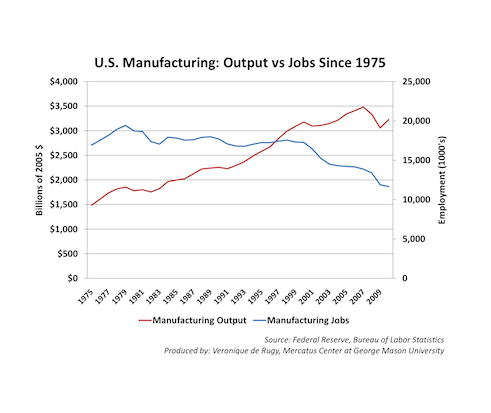
Further, this stance has little factual basis. Automation replaced far more workers than outsourcing. In both cases, high labor costs in the U.S. forced employers to make economic decisions. However, manufacturing continues to grow here even as manufacturing jobs decline.

High Union wages and inflexible work rules led to the migration of manufacturing to right-to-work states, mainly in the South and abroad. Bringing these jobs back to the Rust Belt in any number can only be done at a very high cost, especially if the jobs are unionized. 

While China gained unfairly with subsidies to specific industries such as steel, other friendly nations benefited from globalization as well. Building a fortress America producing everything here is a pipe dream. We can’t make everything and must sell farm goods to others. We have more job openings than people looking for work now. Where would we even get the people to produce everything we need? Higher costs will add to inflation.

While we expect progressives to indulge in fantasies, Republicans should know better. Since the rise of capitalism, no government-directed economy has produced anything close to its results. An elite group of “brilliant” people at the top never matched the mass market’s verdicts. One reason is people will always make mistakes; the market punishes the failure and directs resources in successful directions. Political leaders are loathe to admit defeat. As we’ve seen, stakeholders demand bailouts rather than lose out.

Republicans must be aware of today’s industrial policy. A significant part of which is the Green New Deal. Its present form is simple-produce all our electricity with solar and wind to power everything. Plug in your Industry, your home, and transport. Subsidies, regulations, and protection will make it happen quickly to save the planet. What could go wrong?

Unlike Ford, GM, and others, the #2 auto producer Toyota has resisted the total Electric Vehicle approach. Its lineup in the future includes hybrids and hydrogen-powered vehicles. The company has a long successful history with gas-electric, but why hydrogen? As a significant heavy truck producer, it knows electricity with its heavy batteries isn’t suitable for large loads. Hydrogen makes more sense. That fact will spread hydrogen stations across the world.

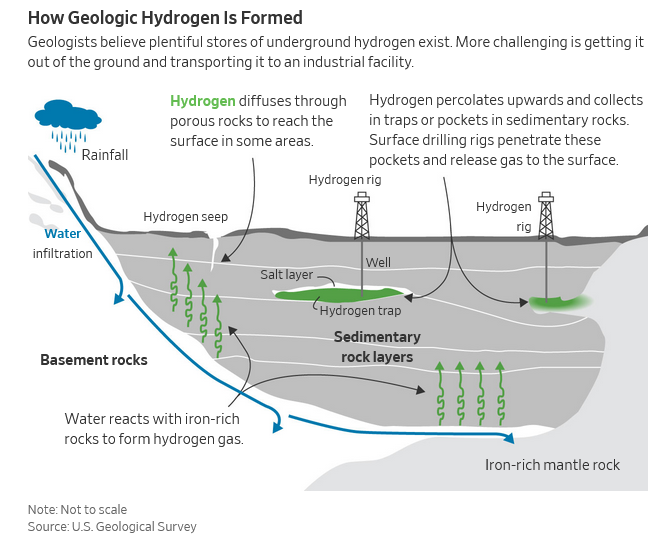
While hydrogen presently requires large amounts of electricity, naturally occurring hydrogen may become available. How ironic is it oil and gas drillers have run across deposits in the past but were not needed then? Using A.I. to go back over their data could be illuminating. The same oil and gas industry may still power the future.

We are still determining if hydrogen or another source will power us. The truth is nobody knows. Rather than betting the house wind and solar to power everything, including autos, the capitalist solution is to let the market sort it out. 

We’ve seen enough results of significant decisions by ruling elites that people wouldn’t do without mandates. China’s one-child policy and the extended covid lockdowns come readily to mind. Those disasters will affect us far into the future.

Republicans have to figure out who they are. Adopting capitalism has bought “More” by far than any other system. Why would you want to copy the top-down Soviet economy that lost the cold war to be another failed industrial policy state?

As China turns away from the free market, maintaining classical liberal policies here will leave it in the dust. It worked before, and there is no reason to think it won’t work again.

Rather than erecting trade barriers, let’s widen trade with our friends. Trump and the Democrats dumped the Trans-Pacific Partnership. We have yet to conclude a liberal trade agreement with the U.K. Rather than trying to do the impossible of producing everything here, let us diversify our supply chains with friends and those obeying the rules.

Most countries know China’s problems and are making market decisions to rely less on that nation. We should join them. As China loses business, it may even change. With a rapidly aging, unbalanced population China might become aware it needs to return to markets and friendly trading partners.

Some Republicans hold up Trump’s anti-trade tirades and tariffs. For all his bluster, his trade deals favored expanded trade, and his tariffs only hurt us. How can you follow a guy who thinks China pays the taxes rather than our importers? We write the checks right here.

Republicans signing on to Industrial Policies need to switch parties or do some summer reading. Adam Smith’s Wealth of Nations, Frederick Hayek’s Road to Serfdom, and the more recent Super Abundance by Marian L. Tupy and Gayle L. Pooley might give them some idea of what works. If you want to win, this is a place to start.