If the President is to appear anywhere in public we see massive security. Inside everyone attending is checked. Outdoors, rooftops are secured and surroundings are constantly scanned. Helicopters overhead survey the entire area. Sharpshooters are there to respond. These efforts are totally understandable as our presidents have far too often been attacked, some with fatal results. They’re always a target. What has changed is the attending crowds and indeed crowds anywhere are now targets. We have developed elaborate actions to protect our president but crowds as the world is now realizing haven’t been given needed protection. The horror in Las Vegas underlines this simple fact.
Author: Dave Davis
Living in a World of Symbols and Labels
When the news isn’t dominated by disasters, natural or man-made, we see a war of symbols and labels. Statues of Confederate leaders are symbols of white supremacy, tear them down. Pro football players taking a knee during the national anthem are making a symbolic statement against police brutality. Others cry they’re disrespecting our symbols of our freedom. Words such bigot. elitist, racist, establishment, deniers of either science or free speech are all tossed about like so much confetti. These dominate the discourse between members any political persuasion. Symbolic gestures and name calling have effectively replaced the actual hard work of problem solving reform.
Some Comparisons between Medicare for All, Graham-Cassidy and Dave’s Plan
With Obamacare in it’s death throes, we’ll probably have to choose between three ways forward. We’ll try to help by comparing Sander’s Medicare for All, Graham-Cassidy and and our own Dave’s plan in 4 crucial areas:
Trump & the Game of Thirds
Setting up a new camera brought to mind thirds as in the “Rule of Thirds.” Composing a shot, one might think the subject should be centered, but this is wrong. The idea of the “Rule of Thirds” according to Google “ means that the subject isn’t centered in the image, which is how many new photographers frame their shots. Instead, the main focal point is a bit off to one side. … Using the rule of thirds draws the viewer’s eye into the composition, instead of just glancing at the center.” Painters also have long used this rule. Take a look at Winslow Homer’s 1889 painting “Deer in the Adirondacks”
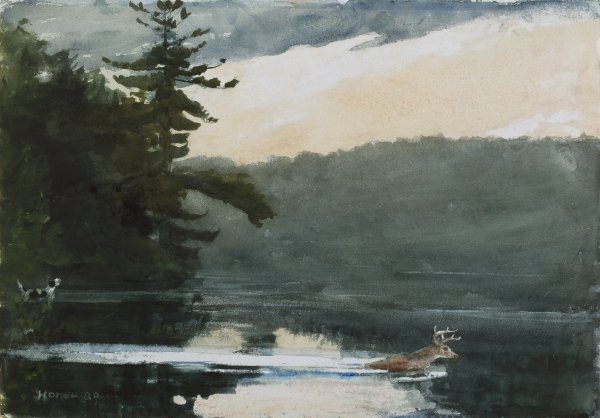
No question the deer is the focal point but the other elements make the painting interesting but secondary.. How many moments passed before you noticed the dog?
The thought came to us that maybe Donald Trump is a master of thirds. When he’s seen against the background of opponents he stands out in relation to them. When he is viewed centered in isolation he can seem diminished with all his flaws evident. By sparring with the press, political antagonists or anyone else in his way, he can stand out against the background they provide. In the “Access Hollywood Incident’ he was alone front and center and made smaller. On the other hand, sharing the scene with his opponents on a debate stage allowed him with his celebrity to make himself strand out from the duller crowd. He knows how to position himself to be the focus while making the whole thing interesting, hence, the constant personal conflicts. He needs them to complete the scene.
Think Cats & Dogs
The recent problems in Charlottesville and Berkeley got us thinking about how we can have protests and counter protests with each having their say without the shadow of violence being cast over all. Remember, we have a constitutional right to freedom of assembly. Maybe some simple commonsense rules could allow both sides to actually get their message out without interruption. Let’s say Group A applies for a Rally Permit for a public location such as a park. Opposition Group B upon finding out about A’s permitted rally also apply for a rally permit. (If one group needs a permit then both do as equal treatment is a must.) How should the Governing entity proceed?
- Which Group has preference? Group A had the permit first and is entitled to a hold their rally in peace at the permitted location. Group B must go elsewhere.
- Where? A different location a safe distance away.
- How would the distance be determined? The very minimum distance allowed would be simply if Group A can hear can hear anything from Group B, B is too close. If Group B can drown out what Group A has to say then they have a veto over A’s free speech. Think of the Verizon guy asking “can you hear me now.” If A can hear B, the latter is too close.
- Is their any circumstance where a member of group B could attend Group A’s rally? If Group A allows for a Q & A session some of Group B with legitimate questions should be allowed but only if Group B reciprocates at their rally. Even then the questions should be respectful but the questioner should be allowed a followup just as in press conferences. Free speech should foster a dialogue between opposing points of view and this would encourage it. If B’s rally has no Q &A, none of their members would be allowed to attend A’s rally and visa versa.
- What else? You can’t have a Rally if people aren’t allowed arrive and leave safely. Safe corridors to the rally location are essential. They should be made clear to all and enforced.
- Can we divorce ourselves from using our own likes and dislikes in decision-making and planning? Think of group A as fervent dogs lovers and Group B as equally fervent cat lovers. That might help in arriving at balance.
 Detour on the Road