Some Thoughts

We’ve known almost from the time China admitted the contagion, only 15% of the US population would be at risk of severe complications from the Coronavirus. The rest will have, at worst, have the equivalent of a cold. Many, if not most, will hardly be affected. Importantly, those really at risk are, for the most part, easily identifiable. The medical community knows who is under cancer, diabetes, heart and kidney treatment, or anything else might compromise immune systems. We know exactly where all the nursing homes, assisted living, senior communities, and senior centers are located. Would it have been better to segregate and protect these communities, rather than disrupting the lives of the other 85% at an enormous cost? After all, the fear is our ICUs, and other medical facilities will be overwhelmed by a spike. The ones most likely needing hospital care are the at-risk group. A healthy 20-year-old isn’t going to tax the system. By making a massive targeted effort to slow down, the spread among the older and compromised population would’ve lessened a crunch and made it manageable.

Meanwhile, the rest go on as they would in a bad cold or flu season. It wouldn’t have been fun but might’ve been better than the total dislocation we’re experiencing. The virus would’ve spread rapidly throughout the younger and healthier population. However, the immunity that comes from once having it would also spread quickly, bringing an end to the epidemic. In this case, the old saying “time is money” is true to the tune of trillions. In this worldwide panic, it seems any cost-benefit analysis hasn’t even been considered.

Italy was slow to take action on movement to and from China, resulting in it being massively struck. Its single-payer health system fell behind and suffered the dreaded spike where it was overwhelmed, resulting in a high death count. Italy’s generally older population probably contributed, but that was a given. It will be interesting to see if the faster spread in that country leads to a swifter epidemic fade. If true, they might have a high death rate but a speedier return to normal. If this is the case, the idea of making every effort to protect the vulnerable while leaving the virus to run its course through the younger, generally healthy public was worthwhile. We didn’t do this. Older people are just now getting help with things such as food delivery and shopping priority at stores while they shelter in place. Segregating this population from the mass population requires reliable support these vulnerable groups are just now getting. While data from China and South Korea, among others, pointed out where the real mortal danger was. There was a bureaucratic failure of the CDC and the FDA to enlist all private government sources in widespread testing. This deprived us of knowing who needed to be kept away from the vulnerable and visa versa. Still, we knew enough to require protective garb for those serving nursing homes and assisted living and other identifiable at-risk people. Maybe an earlier bullet rather than a belated shotgun blast was the way to go. Unfortunately, this just isn’t in the bureaucratic DNA.

Amid all this turmoil, this remains an election year. The Democrats have concluded Bernie Sanders accomplished his task of moving the party to the far left. He and his election losing socialist label now can be safely dumped. Unfortunately, the only alternative they had left was good old Uncle Doofus, aka Joe Biden. Joe seemingly has a clear path to the nomination. It has been pointed out our prediction of a hung convention giving the nod to Michelle Obama is a dead letter. We beg to differ. No matter what closet they hide good old Joe in, he still has seven months to be Joe. Does anyone really think he can go that long without a significant gaff or worse a defining senior moment?

The Democrats didn’t get rid of Bernie only to nominate another undetectable. Joe has always been a walking gaffe machine. However, his ugly attack on a gun-owning voter just asking a pointed question appeared to indicate something else. It looked like the actions we’ve seen in older friends and loved ones. Angry uncalled for outbursts more often than not accompany the onset of some form of dementia. If we saw it that way, others also see it. Can the Democrats take that risk? Gov. Andrew Cuomo of New York apparently doesn’t think so. How else do you explain his almost endless daily coronavirus news conferences? No other Governor even comes close to his TV time. He is running for something, and unless he gets a quick sex change operation, it isn’t Vice-president. If he sees an opening due to a medical drop out(or push out) ending Joe’s run, party movers and shakers also see it. Joe leaves before the convention, leaving it wide open. In that case, Michelle is a much better spot than Andrew or anyone else. Place your bets.
As Compared to What?

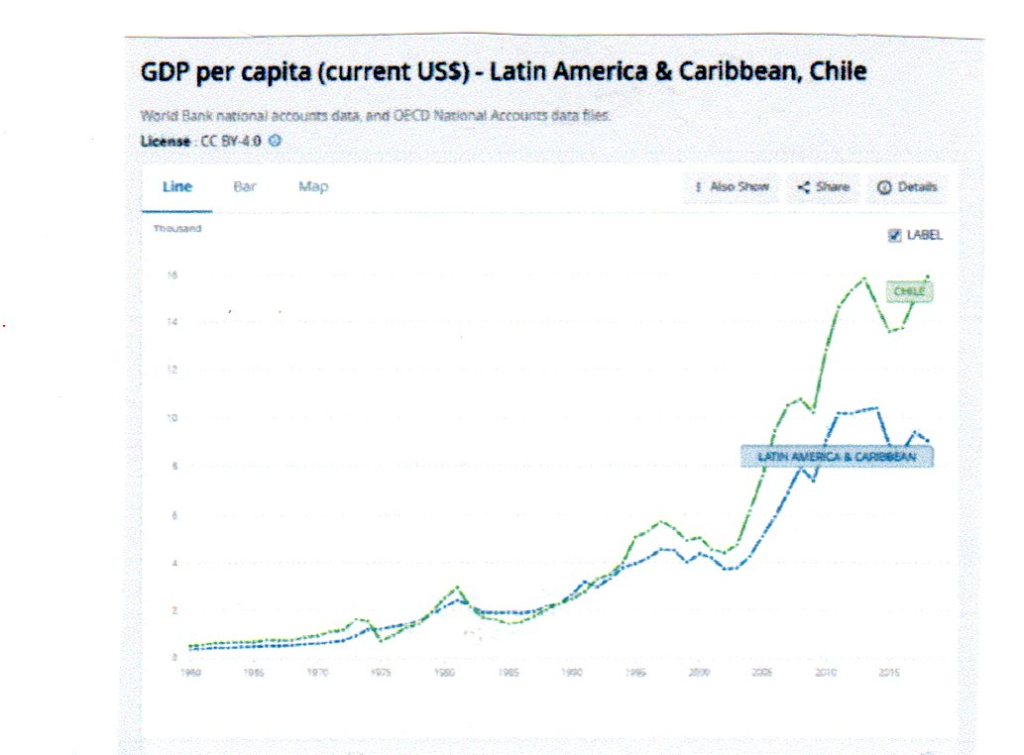
In April, Chile will vote on how to go about changing its Constitution. This is in response to widespread rioting. The present Constitution is the work of the Military Dictator Augusto José Ramón Pinochet. (1973-90). With inflation running over 150%, the country has no foreign reserves, and GDP is rapidly falling. The Government has confiscated over 600 businesses. No wonder people want a massive change. Oh wait, those were the conditions under the Government of the elected Socialist President Salvador Allende, Pinochet overthrew. Today’s protests began over a raise in subway fares. They evolved into demands for cheaper medical care and education, more substantial retirement funds, and an end to income inequality. One might think Chile is still suffering from economic failures dooming it to trail all the other Latin American countries. Fortunately, since the adoption of the Pinochet constitution in the 1980s, as the chart shows, Chile has, in fact, separated itself from the pack in a positive way.


Under the influence of the “Chicago Boys,” a group of Free Market economists from the University of Chicago, Pinochet reversed and/or liberalized the policies of the previous Socialist regime. This resulted in “More” for Chileans at every economic level. This trend, as we can see in the chart above, accelerated after Pinochet retired, and Chile returned to full democracy in 1990. How fortunate are the Chileans? They had a dictator who walked away after losing a referendum leaving a prosperous, democratic, free-market economy. If only we could convince other dictators to follow his path. It’s revealing the country Chile replaced as Latin America’s economic leader was Venezuela. That nation now at the bottom.

So why the big push for change? Who wants to toss this successful structure? The culprits appear to be a coalition of the educational establishment, students, and civil servants. These have been joined by unions, much of the press, and left-leaning politicians. Together they are convincing the populace the nation and economy aren’t working for everyone. Even though everybody has gained, many have been convinced some aren’t “paying their fair share,” resulting in severe income inequality. It is well to remember this was Hugo Chavez’s message to Venezuelans. The result was one of the swiftest transitions from people having “More” to a people not having just “Less’ but next to nothing, in history.

Now you might be asking, why point out the foolishness of some faraway country changing willy-nilly from a successful system to something potentially much worse. Sometimes it’s easier to see the folly in the actions of others at a distance than noticing the same thing happening right under your own nose. If you haven’t noticed, the clamor for significant structural change is occurring right here in the good old USA. The same general groups, as in Chile, are pushing the same themes here

At a time when our people at every level are enjoying “More,” why are so many disaffected? Why do many well-educated elites obscure evident progress in favor of sowing discord and division? The same groups favoring discarding the present Chilean Constitution are propagating the myths of extreme income inequality and the nation’s tainted past resulting in an unfair society. We see this not only here but all over the world.

The answer is in the history of elitism through the ages. Before the 15th century, the world’s mainly agrarian-based societies were sharply divided between the small minority educated elite and the illiterate living at subsistence masses. Stuck in the middle where the relatively small number engaged in commercial interests. These entrepreneurs depended on the goodwill and protection of the elites. The elites tolerated those in commerce as the providers of the better things in life. More importantly, they were a great source of revenue. The elites provided organization and some degree of protection at a price having most everything above what was needed for subsistence. They were the “Betters” in any society.

With the advent of higher carrying capacity and efficiency of ships and far more full literacy, trade and innovation brought ever-increasing change. The change wasn’t the friend of educated elites at the top. Where commerce served them in the past, commerce demanded of Government serve the wider society. Change threatened them. Instead, elites deride capitalism. We don’t even do much teaching of our economic system. We see a revival of socialism and mercantilism among many of our leaders and potential leaders. These are top-down systems, with elites making the decisions. No wonder they’re favored by the self-described “best and brightest.” No matter the fact these systems fail to deliver for society at large, it works for them. Their main job is convincing people to toss out what actually works and put them in charge. What is terrifying, they might succeed not only in Chile but in our own country. Maybe it’s time to ask “Compared to what ?” before turning away from real success and embracing the siren songs of the would-be controlling elites.

The Road to a Better Middle East Future Runs Through Erbil

What do we do now? What we should’ve done years ago. Establish our Middle East Bastion in Kurdistan. Train and arm the Kurds to protect themselves and us. The Shia dominated Iraqi Government has passed a non-binding resolution for Americans to leave their country. Given how our last Iraq withdrawal turned out, this can’t even be considered. However, it gives us another chance to exert control in a strategic part of the world. As we pointed out in our 2014 & 2015 “Shhhhhhh” Middle East posts, turmoil in the Moslem World has brought problems to the fore we can’t ignore. Radical Muslims are attacking everyone disagreeing with their dogmas worldwide. There are threats to the world’s oil supply. Mass migrations of the displaced and the possible destruction of Israel. The extermination of minorities demands our interest, whether we want to engage or not. Even Trump had to realize his withdrawal from the Kurdish areas along the Turkey-Syria border was boneheaded. In the end, he had to keep troops in Syria after all. We can reverse this significant mistake by making a move to Kurdistan. The Shia dominated Government in Baghdad would hardly risk the breakup of their country. In any case, they probably would prefer we stay close by as an offset to Iran and to prevent a re-emergence of ISIS. 

We realize this is a very unpopular idea in some quarters. Across the political spectrum from Rand Paul to Bernie Sanders, the proposition of involvement in areas “far from home” violates American principles. They say we should stay at home and mind our own business just as the founding fathers handled things. Of course, this was never historically true. In just the 1st quarter-century, after the ratification of our Constitution, we were involved in hostilities beyond our borders. Mostly they were over commerce and free seas. We even established a Mediterranean Naval Squadron and, for most of our history, maintained it. We were also involved in regime change in a foreign country. As we established in our series on “More,” trade is one of the three ways you can get it. The idea we can retreat into a shell and let some else handle the world’s problems is fanciful. Do we really think Iran, Russia, and China have our interests at heart? 

Continue reading

2020 Vision

Another year in the books. Last year at this time, we took notice of President Trump’s desire to leave Syria. We pointed out this would stab our Kurdish Allies in the back, while leaving us much worse off. This year Trump pulled our small force out of the Turkish-Syrian border area and sure enough we are worse off. Forced to realize his error, he then kept some troops “to guard the “Syrian Oilfields” and of course more troops in Iraq. The result is distrust of the US by our allies in Syria, Kurds, Canadians, British and French. Americans are under fire in Iraq and and there is a impending humanitarian crisis if the last NW Syrian stronghold falls to Assad’s forces. China, Russia, and Iran hold joint naval exercises in the Gulf of Oman. We suggested it would be better to quietly base in Kurdish Iraq, arming and training the Kurds. They are a people faced by enemies on all sides. With our and tacitly Israeli support, the reverse would be true, the Kurds threaten everyone else. As their benefactor, we would hold a very strong negotiating position to our benefit. Instead our small forces in the area are attacked by Iran backed militias. We are faced with responding and escalation or run. Our real friends rightly question us. After all, the only ones Trump refers to as friends are Erdogan, Putin, Kim and Xi. If these are your friends, who are your enemies? Trump continues to flounder. People pointlessly die.

We also saw some hope we would see expanded incentives to increase savings. While some progress has been made, there is still isn’t proper recognition of savings relationship to healthcare and overall well being. Given greater limits for 2020, Health savings Accounts (HSA) will continue to be the fastest growing health choice. This should make us aware normal market based solutions will be preferred if just given a chance. Dave’s Plan (Series available on this site) would implement these principles universally. We stand ready for a Congressional Budget Office side by side comparison with any of the other plans. Let everyone see how “Medicare for All” or Obamacare actually stack up. Just the elimination of most third party payments and credit risks will lower prices. Marketing directly to individuals will bring forth a much more efficient and responsive system. In any case the possibility of Obamacare being dumped or severely curtailed by the courts in 2020 should focus everyone on real solutions to our personal finance problems, highlighted by healthcare. Can all these people running for office including Trump really go into the 2020 campaign with no clue what to do to provide reasonable effective healthcare?

So it goes, nothing actually gets solved. The debt grows, dreamers live in fear of what comes next, problems face us in every corner of the World, and the list goes on. We confront these problems with fewer friends and because of the rampaging growth of entitlements less fiscal flexibility. With 2020 a big Election year one would think we would be inundated with fresh ideas on how to move forward. Instead, we’re getting recycled Mercantilism and Socialism. The progress of our country has paralleled the ever widening openness to ideas and those that have them. Our Capitalist Republic is built on the basis of having the widest choice of ideas, products,services, leaders, or whatever. Instead, all we hear is calls from our two controlling parties for narrowing of our choices. Whether it’s Trump’s mercantilism, Berniie’s Socialism, Elisabeth’s Fascism or every politician spending other peoples money, we seem to have fallen back on failed ideas. Maybe our bet for the Democratic nomination, Michele Obama , will actually come up with something workable, but I wouldn’t hold your breath. After all, it was her husband who told a business owner ,”you didn’t build that.” As we have pointed out in our series on “More” ( series available on this site) we get “More” by taking from someone else, trade for it or create it through innovation. We now have a resurgence of the former over the latter two to the detriment to civilization. Our hope for 2020 is a recognition of what works and what doesn’t and we move in the right direction.