Some Observations

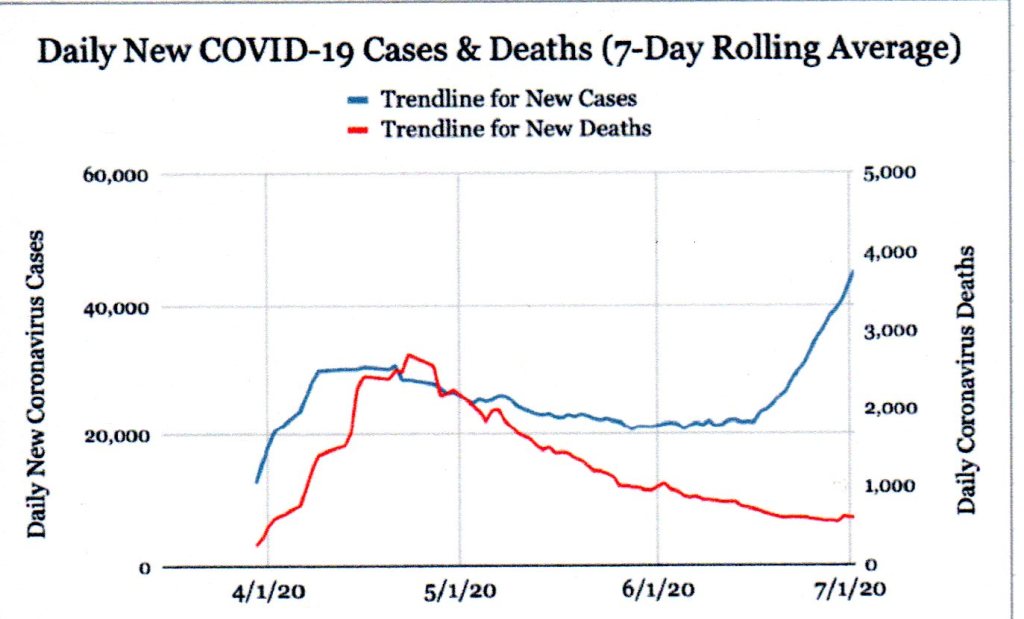
It is interesting to observe some of the things I predicted would happen have taken place. If we did a better job of protecting the elderly and others with underlying conditions, I said we could reopen the country without causing a massive death toll. Younger and healthier people may get the coronavirus in higher numbers, but very few would die. Most of the country has now been opening up. Protecting the vulnerable has been better. Also, people at risk and those close to them are more aware and have taken proper actions. Mask wearing other PPE use around the vulnerable has dramatically expanded. Even Gov. Cuomo now seems to recognize nursing homes must be protected. We still haven’t taken all the measures I proposed, but we have made progress. If better-targeted protections didn’t reduce mortality, then increasing confirmed cases would lead to increased deaths. This chart shows otherwise. Cases have significantly increased, but as I predicted, fatalities haven’t.
Early on, I also wondered why mask-wearing, especially where vulnerable people are present, wasn’t at least encouraged. Even though masks were widely worn in Asia where they had better outcomes, it wasn’t until April 3. The CDC reversed itself and favored masks. There was a shortage of medical gear, but the CDC in April encouraged homemade masks. Peop[e responded. Nothing prevented earlier adoption. This waffling by the authorities has led to needless controversy. Until now, our President seemed to resist wearing a mask. He should’ve set the right example. Can we all agree to wear a mask whenever you might be near an at-risk person? You may save your grandma.

Our failure to do targeted things to protect the at-risk early on has caused needless deaths. Now that more is being done, the results are evident. The better job we do protect the at-risk, the lower the number of deaths. That was always the choice. Not the false one of lives vs. the economy expounded by so many of our leaders.

n my posts at the time of the Ferguson, Mo in 2014 riots after the death of Michael Brown, I warned of the “Ferguson Effect.” If the police were placed in a no-win situation, they would be much less aggressive. This would result in rising crime and murder rates in lower-income areas. The statistics since have borne this out. Rather than recognizing more deprived regions anywhere in the world need more not less police presence, the police are demonized. Instead of striving for a workable community balance to improve the lives in higher crime areas, we have gone in the opposite direction. By disrespecting policing to the point of defunding, the predicable rise in minority deaths is already occurring. This will only get worse. We will see even more Blacks’ lives lost. We are endlessly told “Black Lives Matter,” but do they? To whom?

Continue reading

Wealth And How To Get It

The prevalent idea promoted across much of our media is the vast disparity between white and black wealth is indicative of “systematic racism.” No matter the reason, the gap exists. What is lacking actual proposals to increase black or anyone else’s wealth. What is offered generally involves money transfers or mandated higher wages. This may or may not increase wealth, depending on whether the additional money is saved or consumed. Wealth is just another way to say net worth. We determine our net worth by subtracting what we owe from our assets. What is left is our net worth.

An easy way to understand this is to look at how many people’s two biggest assets would determine one’s net worth. Say you buy a house for $100,000 and auto for $20,000. You were able able to acquire both with 10% down and to borrow the rest. You have $120,000 in assets and debt of $108,000. That leaves a $12,000 net worth. From that point forward, we have to mark the assets to their present market value. Autos are a depreciating asset. They lose value the instant you buy one. Real estate may depreciate or appreciate depending on several factors, the greatest one being location. If the real estate fails to appreciate and the car continues to depreciate, you’ll have a declining net worth. It could even turn negative. Keep this in mind.

Only the portion of one’s income actually saved can add to net worth. Unless it is used to obtain a capital asset, it cannot grow. Putting money in your mattress stays the same. If the assets acquired appreciate it adds to net worth. Maybe the asset gives a return of interest, dividends, or net rent. If those are reinvested, they can also add to wealth. If the value depreciates, your net worth reflects this adversity. This is all basic stuff but is often overlooked.

How do we help those with a net worth deficiency? I submit the “Expanded Dave’s Plan” would be an excellent place to start. Everyone has a Personal Benefits Account (PBA). It consists of two sub accounts at the financial institution of their choice. One combines all tax-favored savings accounts and the other a regular bank account. A catastrophic Health Care plan is associated with the tax-sheltered account. Significant medical bills can wipe out savings, but here we have protected them with a Catastrophic Policy. Employers and governments contribute proper benefits directly into the appropriate account. They’re yours even if you change jobs, locations, or both.

Continue reading

A Different Perspective

What if the Floyd and Brookes families had migrated to Ghana? The nation on the West Coast of Africa was the first Sub Sahara British Colony to get its independence. Relatively prosperous, the English speaking nation might be a reasonable destination for Blacks uncomfortable in the US. Unfortunately, fate still plays out in the new location. George Floyd passes a counterfeit bill at an Accra market and gets arrested. The arresting officer in charge has him down and presses a knee on Floyd’s neck till he dies, while other officers standby. There are several onlookers, some recording the incident. The offending policeman appears to be aware of their presence but doesn’t seem to care. Everyone is shocked at a seemingly senseless murder. Why did the policeman do it? Investigators look for clues. It’s determined that the policeman likely knew his victim. The policeman’s wife left him the next morning, Maybe he had a domestic crisis. Did he have a breakdown? Both men worked at the same nightclub. Floyd had multiple drugs in his system. Did any of this play into the officer’s murderous decision? Investigators work to solve the mystery.

Rayshard Brookes was found passed out in the drive-thru lane at an Accra fast food restaurant. The police are called, and they find Rayshard is intoxicated. Everything is peaceful until they arrest him for DUI. Brookes then attacks the policemen, grabbing one of the policemen s taser. He tries to flee but fires the taser at one of the officers. The policeman returns fire, killing Rayshard. All of it is caught on tape. Police investigate to determine if it was a reasonable shooting.

This sounds pretty much like what happened to Floyd and Brookes in Minneapolis and Atlanta. Bad things can happen in Accra or most any other city in the world. Someone in law enforcement suddenly commits an unfathomable act or kills someone resisting arrest. So what makes the same thing happening in Accra rather than the Twin cities or Atlanta different? There is no question of a racial motive by law enforcement. Ghana’s population is almost totally black. They have excessive force issues like any other city in the world, but obviously, it’s not based on race. They investigate each case based on the actual facts, not “institutional Racism.”

Does this mean there is no bigotry based lawlessness in the US? Of course not. I think Ahmaud Arbery’s death will prove to be a result of prejudice. We know it was behind the Charleston church massacre. However, ugliness isn’t confined to just blacks and whites. Lives were lost in the conflict between Jews and Blacks in Crown Heights, NY. Race-based gangs battle each other in and out of our prisons. But there is no basis to believe all deaths of Blacks at the hands of white policemen are racist.

The reason I say this is the problems between police and the residents of less wealthy areas of cities is a problem the world over. Almost every city we visited the world over had dangerous areas tourists were advised to avoid. This is true, regardless of whether it entails more than one race or not. Accra is an almost totally black city that doesn’t shield it from friction between the police and residents. More impoverished areas have more crime. Those crimes tend to be more violent. These areas need more policing to protect those living there. More police mean more encounters. That means more chance of ugly incidents. If the police pull back, the residents suffer. If the police feel you’re throwing them under the bus, few good people will want the job. Finding the proper balance is the “Holy Grail” for police departments across the globe.

Continue reading

I Was Wrong

We’ve all have seen the experts standing either with the president or appearing around the clock on TV. Supposedly, they’re enlightening us on the Coronavirus epidemic. I assumed most of them were epidemiologists. After all, epidemiology is the branch of medicine which deals with the incidence, distribution, and possible control of diseases and other factors relating to health. It sounds like the ones to be at the forefront of the present pandemic. Worse, I blamed them for the ill-considered lockdowns. It wasn’t till I saw an Oxford-style debate on Reason.com. I realized I was wrong. I received an invitation to view ” Did the Lockdowns Save Thousands of Lives?” a Soho Forum debate featuring Physician Marty Makary vs. epidemiologist Knut Wittkowski. The subject was of great interest as the journal “Nature” recently touted studies showing the lockdowns saved millions of lives. This seemed highly unlikely, and I was eager to see the proposition debated.

I have seen Dr. Makary on several TV programs giving his views on the pandemic as an expert guest commentator. Knut Wittkowski, the epidemiologist, was a mystery to me. I assumed he would be in the affirmative. After all, weren’t we told by those in his specialty lockdowns were essential? It turns out I was completely off base. He argued the negative. It wasn’t the only thing I was wrong about. It turns out the policy of lockdowns wasn’t promoted by all epidemiologists. For instance, there are none on the White House Coronavirus Task Force. What about Dr.Fauci? He’s an immunologist. It turns out epidemiologists played little or no role in the adoption of the lockdowns. Even Dr. Makary commented in the debate, it would’ve been better if more had been in the discussion. I just never also considered there would be few epidemiologists in a dialogue about an epidemic. I failed to take my own advice about jumping to conclusions. For that, I apologize. I knew I was really on the wrong track when Knut stated he wasn’t aware of an epidemiologist advocating quarantining well people. Blanket condemnations should always be avoided.

The debate was highly informative. It seemed to me Dr. Makary never fully supported the idea of lockdowns saving thousands of lives. Knut Wittkowski made a compelling and well-prepared argument in the negative. He really impressed me when the moderator extolled his credentials, and Wittkowski said, forget them and concentrate on his facts and data. Got to love a guy with that attitude. While Reason is a libertarian magazine, the negative won over the undecideds and prevailed by better than 2 to 1 margin. I strongly recommend watching the debate yourself. There were some of the technical glitches common to today’s remote programming, but both sides come through. You can find it on the Reason website under videos or on YouTube.

While I’m making recommendations, Amazon has reinstated “Unreported Truths about Covid-19 and Lockdowns”. The short book by former New York Times reporter Alex Berenson is well worth the $2.99 kindle price. While much of the material will be familiar to readers of this blog, the book well organized and easy to read. I wish I had thought of putting a book out on the subject. I’m glad he did.

Speed Kills

Look before you leap. This idea has long been sage advice. Taking a little time to assess a situation before you take radical action can stop you from a significant mistake. A thorough exchange of ideas and information just might’ve made us hesitate before rushing off to Vietnam and the 2nd Iraq wars. Yet our modus operand lately has been just the opposite. We close down the country before we looked at what could happen from all angles. Many states never considered a more targeted approach. As I’ve pointed out, many people raised red flags about the models and data being relied on to lock down the world economy. Fear, not deliberative thought, ruled the day. Nobel Laureate Michael Levitt, Dr. Scott Atlas, and Dr. John Ioannidis were just some of the luminaries warning this was the wrong path. An army of online skeptics slicing and dicing the rationale for taking such drastic action joined in.

It’s just you never heard them at the time. Once the ruling politicians and the media hastily committed to the lockdown, they became hostile to any alternatives. The media never gave the skeptics much of a platform to inform the public of their doubts and alternatives. Deviating from the dominant solution found relentless attack. Sweden and Florida Gov. Ron DeSantis were the subject of endless mockery. They were comparing Sweden unfavorably to their close smaller neighbors, Norway, and Denmark. Sweden actually falls in the middle of European outcomes with less drastic measures. The media predicted Florida would be a deathtrap for closing down late and opening up early. Early on, the hero of the hour was New York Governor Andrew Cuomo. The Media hailed the N.Y. governor as doing all the right things.

Act in haste, repent at leisure. The ignored skeptics are now looking prescient. Some governments are now admitting acting in haste. Norway’s prime minister Erna Solberg went on Norwegian television to make a startling admission. According to the Daily Telegraph, some, even most, of the stringent measures imposed in Norway’s lockdown now look like steps too far. “Was it necessary to close schools?” she mused. “Perhaps not.” She added, “I probably took many of the decisions out of fear” Even though Norway did well with the virus, it’s success came at too high a price. “Our assessment now that we could have achieved the same effects and avoided some of the adverse impacts by not locking down, but by instead keeping open but with infection control measures,” Camilla Stoltenberg, Norwegian Institute of Public Health Director-General.

Continue reading